What are seller closing costs in Kalamazoo, Michigan?
When you sell a home in Kalamazoo County, your biggest closing costs are usually agent compensation, Michigan's state and county transfer taxes — $8.60 per $1,000 of sale price combined, so about $2,580 on a $300,000 sale — the owner's title insurance policy that Michigan sellers customarily provide, your mortgage payoff, and property tax prorations. If the home was your principal residence and its SEV hasn't risen since you bought it, you may qualify to get the state portion of the transfer tax back
.
By Jason Veenstra | November 2, 2026
Most Kalamazoo sellers I talk with know their list price down to the dollar. Far fewer know what they'll actually walk away with.
That gap is where surprises happen. The good news is that seller closing costs in Michigan are pretty predictable once you know the line items — and one of them, the state transfer tax, is something some sellers can get back.
Here's how I walk my clients through it before we ever put a sign in the yard.

Downtown Kalamazoo, seen from Western Michigan University. Photo: Brob2104 via Wikimedia Commons, CC BY-SA 4.0.
The Main Seller Closing Costs in Kalamazoo County
Every sale is a little different, but these are the lines you'll see on almost every seller settlement statement in Greater Kalamazoo.
1. Michigan state and county transfer tax
This one catches a lot of sellers off guard, because it's tied directly to your sale price. Michigan charges two transfer taxes when a deed is recorded:
State transfer tax: $3.75 per $500 of value — $7.50 per $1,000, or 0.75%
County transfer tax: $0.55 per $500 — $1.10 per $1,000, or 0.11% (the rate for counties under 2 million people, which includes Kalamazoo, Allegan, Barry, and Van Buren)
Combined, that's $8.60 per $1,000 of sale price. Kalamazoo County rounds the price up to the next $500 before calculating.
Here's a quick example using a hypothetical $300,000 sale:
State: $2,250
County: $330
Total transfer tax: $2,580
Under Michigan law, the tax is on the seller. A purchase agreement can shift it to the buyer, but that has to be negotiated — don't assume it.
2. Owner's title insurance policy
In Michigan, the custom is for the seller to provide the buyer an owner's title insurance policy. It's not required by law — it's negotiable — but it's what most purchase agreements call for.
The premium is a one-time charge based on the sale price, and rates are filed with the state by each title insurer. Ask the title company for an actual quote on your price point rather than guessing.

Your title company’s settlement statement lists every line that comes out of your proceeds. (Illustrative AI-generated image.)
3. Agent compensation
Commissions aren't set by law, and they're fully negotiable. Since the NAR settlement practice changes took effect on August 17, 2024, offers of compensation to a buyer's agent can't be posted on the MLS — but you can still choose to offer it, or offer buyer concessions instead.
If you're weighing that decision, I break it down in whether you still need to pay a buyer's agent commission.
4. Mortgage payoff and lien releases
Your remaining loan balance — plus interest through the payoff date — comes straight out of your proceeds. Your lender provides a payoff statement to the title company, and a discharge of your mortgage gets recorded afterward.
In Kalamazoo County, recording fees run $30 per document. Who pays for which recording depends on your purchase agreement.
5. Property tax prorations
Michigan homeowners get two tax bills a year. In the City of Kalamazoo, for example, summer bills are due July 31 and winter bills are due February 14.
At closing, taxes are split between you and the buyer based on the method your purchase agreement spells out. Depending on what's already been paid, this can show up as a credit to you or a charge against you.
Before recording a warranty deed, Kalamazoo County also requires a tax certificate from the County Treasurer ($5 per document). Properties inside the City of Kalamazoo need a separate city tax certificate first ($10).
6. Negotiated credits and repairs
Inspection credits, closing cost help for the buyer, and home warranty costs all come out of your side. These aren't fixed fees — they're the result of negotiation.
If you're in the middle of that conversation right now, read Kalamazoo Inspection: Repairs or a Seller Credit? before you respond.
For a broader look at the other line items sellers run into — settlement fees, prorated utilities, and more — see these common seller closing costs.
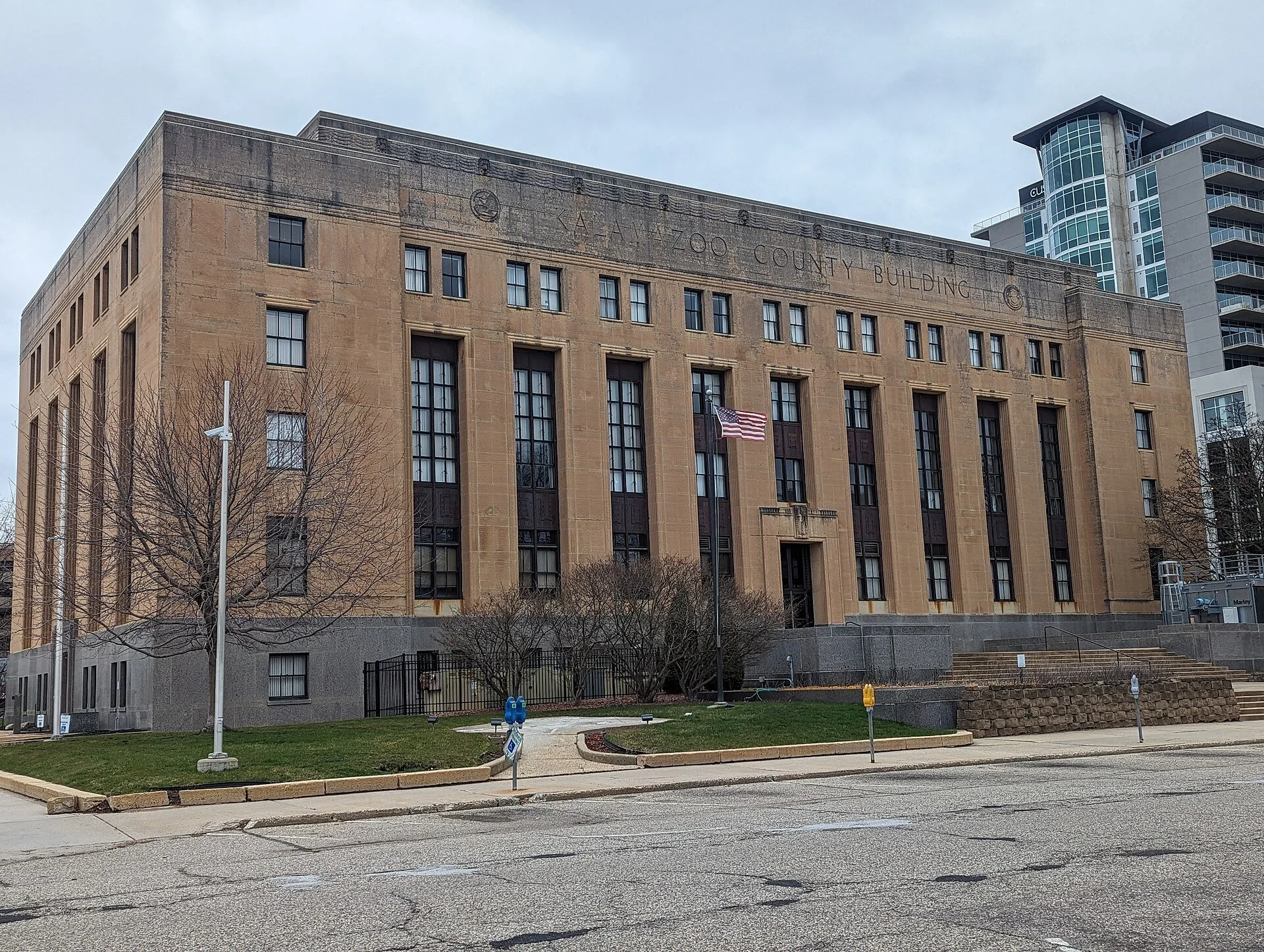
The Kalamazoo County Courthouse in downtown Kalamazoo. Deeds and transfer tax are handled by the County Clerk/Register of Deeds at 201 W. Kalamazoo Ave. Photo: MSwierenga via Wikimedia Commons (CC0).
The Michigan Transfer Tax Refund Most Sellers Never Hear About
This is the part I wish more sellers knew. Michigan law exempts some home sales from the state transfer tax — and if you paid it anyway, you can apply for a refund.
Under MCL 207.526(u), you may qualify if all three of these are true:
The home was your principal residence and you claimed the principal residence exemption (PRE).
The SEV in the year you sell is equal to or lower than the SEV when you acquired it (or the first tax day after a certificate of occupancy was issued, whichever is later).
It was an arm's-length sale — a price a willing buyer and willing seller would reach in a normal negotiation.
SEV (state equalized value) is the assessment number on your tax records — not your sale price. So this isn't about whether you sold for less than you paid. It's about whether your assessed value went up.
A few details that matter:
The refund covers the state portion only — on a $300,000 sale, that's the $2,250 piece.
You apply with Michigan Treasury Form 2796, and only the party who actually paid the tax can claim it.
You'll need your recorded deed (or validated transfer affidavit and receipt), your signed settlement statement showing you paid the tax, proof of your purchase date, and SEV records for the year you bought and the year you sold.
The deadline is four years and 15 days from the date of the sale.
You'll sometimes see companies offer to file this for you in exchange for a cut of the refund. You can file the form yourself.
Whether you qualify comes down to your property's SEV history, which your city or township assessor can provide. This is exactly the kind of thing I check for sellers before closing, so it doesn't get missed.
Two More Things to Handle Around Closing
Rescind your principal residence exemption. Once the home is no longer your principal residence, Michigan requires you to file Form 2602 (Request to Rescind PRE) with your local assessor within 90 days. Skipping it can mean a penalty of $5 a day, up to $200.
Know where you stand on capital gains. Federally, many homeowners can exclude up to $250,000 of gain ($500,000 for married couples filing jointly) if they owned and lived in the home for at least two of the five years before the sale. Your situation may be different, so confirm the details with your tax professional.
How to Estimate Your Net Before You List
The most useful document in this whole process is a seller net sheet — a line-by-line estimate of what you'll walk away with at a given price.
A good one starts with a realistic sale price (here's how to find out what your home is worth), then subtracts:
Your mortgage payoff and any other liens
Transfer tax at $8.60 per $1,000
Owner's title policy and settlement fees, quoted by your title company
Agent compensation and any buyer concessions you're offering
Estimated tax prorations for your closing month
A cushion for inspection credits or repairs
Your specific number depends on your price, your loan, your township or city, and when you close. That's why I run these numbers with every seller before we set a list price — so the offer you accept is one you've already done the math on.
Frequently Asked Questions
Who pays transfer tax when you sell a house in Michigan?
The seller. Michigan law places both the state and county transfer tax on the seller (grantor), and it's paid when the deed is recorded. A buyer and seller can agree in the purchase agreement to shift the cost, but that has to be negotiated.
How much is the transfer tax in Kalamazoo County?
It's $8.60 per $1,000 of sale price: $7.50 state and $1.10 county. Kalamazoo County rounds the sale price up to the next $500, so a $300,000 sale works out to $2,580 in total transfer tax.
Can I get my Michigan transfer tax refunded?
Possibly. If the home was your principal residence with a PRE, its SEV in the year of sale is no higher than its SEV when you acquired it, and the sale was arm's-length, you can apply for a refund of the state portion using Treasury Form 2796. You must file within four years and 15 days of the sale.
Does the seller pay for title insurance in Michigan?
Usually, yes. It's customary in Michigan for the seller to provide the buyer's owner's title insurance policy, while a buyer with a mortgage pays for the lender's policy. It's negotiable, so confirm what your purchase agreement says.
Do I have to do anything with my homestead exemption after I sell?
Yes. Michigan requires you to file Form 2602, Request to Rescind Principal Residence Exemption, with your local assessor within 90 days after the home is no longer your principal residence. Missing it can lead to a penalty of $5 a day, up to $200.
Your Next Step
Seller closing costs in Kalamazoo aren't a mystery — transfer tax, title, payoff, prorations, and whatever compensation and credits you negotiate. Know those lines before you list, and you'll make every pricing and offer decision with real numbers instead of hope.
If you want to see your own net sheet — and find out whether your sale might qualify for the state transfer tax refund — I'm happy to walk you through it. Schedule a 15-minute conversation and we'll go over your numbers together. You can also reach the Veenstra Team anytime through the website.
About Jason Veenstra
Jason Veenstra is a REALTOR® with the Veenstra Team, brokered by eXp Realty, serving buyers and sellers across Greater Kalamazoo and Southwest Michigan. Licensed since 2009, Jason brings extensive local market experience and a family real estate tradition dating to the 1987. He helps clients navigate existing-home purchases and sales, relocation, and new construction.